

Maintaining New York City’s stock of low-cost, affordable and public housing has become increasingly important and urgent since the release of WWL2020. Rising housing costs threaten many New Yorkers’ ability to stay stably housed. As shown in the figure below, tenants report difficulty paying rent, food insecurity, and an inability to afford critical expenses.
Figure 5.9: Prevalence of Missed or Late Rent Payments in Last Year, by Household Income, 2023

Source: NYC Housing and Vacancy Survey, 2023
Figure 5.10: Prevalence of Renters Who Still Owed Rent, by Household Income, 2023

Source: NYC Housing and Vacancy Survey, 2023
Figure 5.11: Prevalence of Food Insecurity, by Household Income, 2023

Many low-income New Yorkers of color are leaving the city altogether, while higher-income, disproportionately White New Yorkers are moving in. Figure 5.12 shows the race/ethnicity of the head of household for these same four groups of renters from the 2023 NYC Housing and Vacancy Survey (NYCHVS) Selected Initial Findings. Among those who stayed, 25% were headed by a White New Yorker, 26% were headed by a Black New Yorker, 35% were headed by a Hispanic New Yorker, and 12% were headed by an Asian New Yorker. A smaller share of those who moved out after the 2021 NYCHVS were headed by someone who identified as a person of color (62% compared to 75% among those who stayed). 58% of renters who moved into these homes were headed by a person of color. Only half of the households who moved to a unit that was vacant in 2021 were headed by a person of color.
Figure 5.12: Residential Mobility Among Renters, by Household Race/Ethnicity: 2021-2023

Source: NYC Housing and Vacancy Survey, 2023
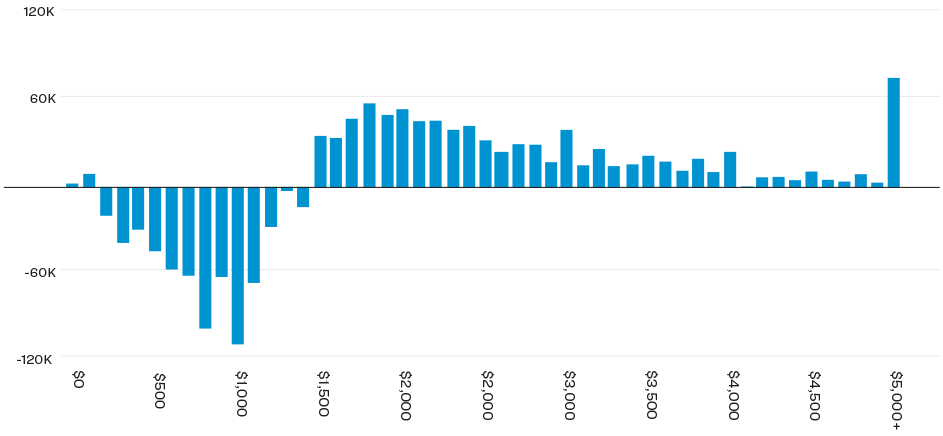
Rents have risen dramatically in the last several decades and the city has lost significant amounts of its low-cost rental stock. Available apartments today are too expensive for the typical renter. In 2023, the median asking rent for available homes was $3,000. To afford an apartment at that rent, a family would have to earn at least $120,000 a year. But the median renter households earned just $70,000 in 2023, making those asking rents almost double what most renting families can afford. As shown in the figure below, in 2023, there was an almost $1,500 gap between median rent and median asking rent – meaning the typical New Yorker would face an extreme increase in their monthly expenses if they had to leave their current home for any reason.
Figure 5.13: Net Change between 1993 and 2023 in number of households paying different monthly rents
Source: NYC Housing and Vacancy Survey, 2023
Operating and maintenance costs are straining the City’s rental stock
The cost of operating privately-owned housing has also become a central issue in the past five years. The economic impacts of the COVID-19 pandemic are still rippling through New York City’s housing stock: owners have had to catch up on deferred maintenance coming out of the of pandemic, accumulated rent arrears, and supply chain and labor shortages—all in an environment of increased financing, insurance, and utilities costs. These increased costs are not unique to New York City but are instead part of a broad national trend. Meanwhile, one of the City’s critical tools to maintain quality housing, the J-51 tax incentive, a property tax incentive which helps building owners offset the cost of major capital repairs, lapsed during this critical period. Through its work with owners, HPD has observed significant challenges across every type of housing in New York City, from affordable rental, to rent stabilized housing, to homeownership. These increasing costs are raising challenges for some building owners, with concerns about the impact on affordability and their own ability to keep their buildings in good health.
Poor housing quality threatens the health and safety of residents
Housing quality directly affects the health and well-being of individuals and communities. When housing conditions deteriorate, exposure to maintenance deficiencies such as water leaks, mold, pest infestations, and lead paint can contribute to health issues like chronic illnesses, respiratory problems such as asthma, developmental issues in young children, and even increased mortality rates. These health issues are more likely to impact New Yorkers of color, for example, who are more likely than white New Yorkers to report housing quality issues (see page 61, WWL2020). When housing quality issues are not addressed, they can exacerbate health inequities experienced by marginalized or otherwise vulnerable New Yorkers, contributing to a vicious cycle of poor health outcomes.
Climate change is increasing risks to housing and residents
Adding to these preservation challenges are the effects of climate change, which increase the vulnerability of both residents and the existing housing stock in certain regions prone to extreme weather events. Residents living in coastal and inland flood-prone communities and neighborhoods subject to greater urban heat impacts are among the most at risk, especially people with mobility disabilities, older adults, and others living in supportive housing settings. In these areas, flooding and other severe weather events not only disrupt daily life but also pose significant risks to long-term health and safety. Extreme weather events, fueled by rising sea levels and other climate-induced changes, can cause extensive damage to properties, displace families, and put already vulnerable populations in even greater danger.
Figure 5.14: Heat Vulnerability Index, 2024

Source: NYC Department of Health and Mental Health
Figure 5.15: Projected Storm Surge Inundation, 2000s to 2100s

Source: NYC Mayor’s Office of Climate & Environmental Justice, 2023
The City’s fair housing goals—from equitable housing development to preventing displacement and improving housing for people with disabilities—are all predicated on a more climate resilient city. The interconnectedness of housing quality, climate change, and health disparities highlights the urgent need for a coordinated and holistic response to address these issues.
WWL2025 recommits to housing infrastructure and repair programs and proposes new investments in climate resilience to safeguard vulnerable populations. For example, the City plans to assess and address threats to flood insurance. WWL2025 also includes commitments to launching a new citywide housing mobility program for residents in severe flood-prone areas and developing a heat mitigation framework for HPD-assisted properties in high-heat neighborhoods. Through leveraging City investments in affordable housing and supporting residents in the most at-risk areas, we will better adapt New York City to a changing climate and make our communities more resilient to its risks.